May 3 – Road to Santa Ana, the Coatepeque Lake Panorama and an Unexpected Police Check
Yesterday we had already figured out the weekend program with the others: Santa Ana, from where we would climb the country's most popular volcano the next day! It lies about 150 kilometers southwest of us, and it was worth planning ahead for more than just the distance. There are strict rules for visiting the volcano, so we decided to travel to the nearby city of Santa Ana on Saturday, spend one night there, then climb the volcano early Sunday morning and return to Bambú the same day.
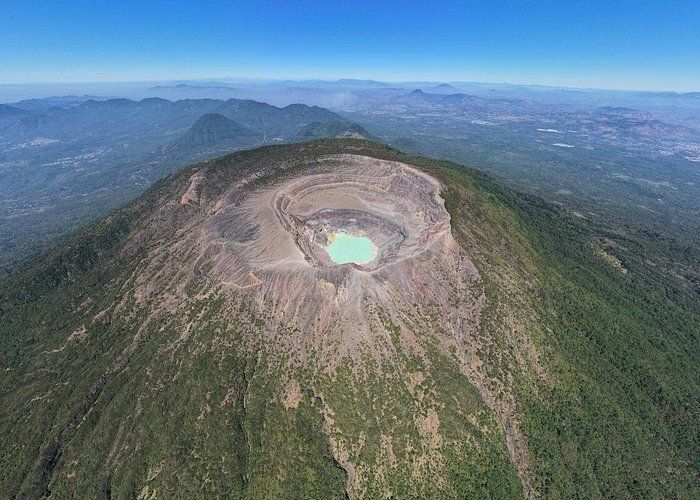
The hike itself isn't too difficult: the 350-meter elevation gain can be done in less than two hours. Santa Ana is not only the most popular, but also the highest active volcano in the country – it is 2,380 meters high and last erupted in 2005. You can only go up with a guide, and the tours usually start in the morning. You also have to pay for the guide and the national park entrance fee.
Over the past few days, finding accommodation had been left to me: I found a cheap hostel close to the city center. Ruben, Karina and Hagen were naturally coming along, but Nathan decided to skip it because he had already been to the volcano – he agreed to look after the farm while we were away. And then came the idea: Ranulfo offered to drive us to Santa Ana. So instead of a 4–5 hour bus ride, it turned into a two-hour drive – a huge help!
In the morning, before leaving, I was having coffee on the terrace when I noticed Karina: she was sitting on the ground with her back to me, looking towards the garden, with Mancs, the black hunting dog, beside her. The scene caught my attention so much that I asked if I could take a few model photos. My new camera is simply amazing – sharp colors, a nicely blurred background, as if I had taken professional portraits. Karina and Mancs were naturally great models.

On the way, Ranulfo suggested that we take a look at Lake Coatepeque, which was right on our route, barely 20 kilometers from Santa Ana. This crater lake was formed tens of thousands of years ago during a massive volcanic eruption – after the magma chamber emptied, the Earth's crust collapsed, and the depression gradually filled with water.
After an hour and a half, we were already there. Ranulfo knew a few viewpoints with restaurants and terraces – we stopped at one of them for breakfast while enjoying the wonderful panorama of the lake, and he told us about the history of the place.


Ranulfo dropped us off in the center of Santa Ana – huge thanks for the ride! Our first stop was the hostel, where we checked in. It was only a ten-minute walk from the city center, a simple but beautiful colonial-style house with a spacious inner courtyard and a swimming pool. The boys – Hagen, Ruben and I – got a room together, while Karina shared a room with other female travelers.
After dropping off our stuff, we went out to explore El Salvador's second-largest city. It has barely a quarter of a million inhabitants, but its history goes back thousands of years: according to archaeological findings, the Maya already lived here, the Spanish arrived in the 16th century, and although it became independent in the 18th century, the cityscape still preserves traces of the colonial period. Beautiful churches, a theater, government buildings – everywhere you could see traces of past centuries.

While wandering around aimlessly, we came across a coin museum. It was small, but all the more interesting: a mint used to operate on the site. Besides El Salvador's monetary history, we learned a lot about the country, its culture and its people – especially relevant experience for Bitcoiners!

After lunch, Hagen wanted to buy some clothes, and Ruben recommended a popular second-hand chain called Megapaca. It was a twenty-minute walk from the city center, so we went on foot to get a better feel for the real Santa Ana. Outside the city center, however, especially around the markets, we were greeted by a lot of garbage and dirt – that always bothers me, wherever I go.

The store was smaller than we expected, so Hagen didn't have an easy time finding anything. We thought that later we could play cards in the hostel courtyard, but nobody had a deck. I figured they probably sold them here too – besides clothes, they had all kinds of used things, children's toys and kitchen utensils. I found a deck of cards, but before paying for it, I checked it: it was missing cards! I had a good laugh at the checkout and asked for another one. That one was incomplete too.
The woman started opening one deck after another, and even called the security guard over to help – it was an incredibly funny scene. Finally, after the fifth or sixth deck, we managed to find a complete one.

We got back to the hostel with an hour left before sunset. We quickly jumped into the pool – it was cold and the sun was almost setting, but it felt amazing. After drying off quickly and changing clothes, we were hungry again, so we looked for a pupuseria nearby.
We chose a busy place where they made pupusas almost on an industrial scale right in front of the customers. We ate 3–4 each – after Doña Reina's, these were the best!
Back at the hostel, we sat out on the terrace playing cards, and as time passed, more and more people gathered. It turned out there was going to be live karaoke in the courtyard! Some people sang well, others not so much – but the atmosphere was great. We ordered sangria from the bar, put the cards aside and enjoyed the music.

It was slowly approaching midnight when uniformed police officers walked into the courtyard. The music quieted down and many people were surprised – we guessed they had come because of a noise complaint. But they reassured everyone: it was just a random security check.
Since President Bukele came into office, there have been many more police officers on the streets, and because they are well paid, they are not corrupt. We handed over our passports, got them back after a quick check, and the police officers left. Relieved, we continued the evening.
May 4 – The Santa Ana Volcano Crater and the Adventurous Journey Home
We were already on our way before seven in the morning, because the day of climbing the volcano had finally arrived. We quickly got ourselves ready at the hostel, then walked to the bus station, where a bus packed with tourists was already waiting for us.
The two-hour journey took us to Cerro Verde National Park, which lies at 2,030 meters – not that far below the nearly 2,400-meter summit. The road was naturally full of hairpin turns and steep climbs, since the city of Santa Ana is only 665 meters above sea level, but we didn't really feel the extreme elevation gain from the bus – instead, we simply enjoyed the beautiful forested mountain landscape.

As soon as we arrived at the entrance to the national park, a group of tour guides greeted us and divided the 30–40 tourists waiting there into groups of ten. They explained that the route to the summit was 7 kilometers long, and that along the way we would have to cross private land, where we had to pay a few dollars as a crossing fee. At a good pace, it was possible to reach the summit in three hours – that was the plan.
The first half of the hike was still quite easy: it followed a shaded forest trail with a gentle incline, almost like a rest compared to what came later. Then the landscape became increasingly barren, rocky and steep.

I'm not an experienced hiker, but luckily I run a lot in my free time, so I handled the climb well. During the last half hour of the hike, we even had to climb in places, and there were quite a few people ahead of us who had to stop and rest because they simply couldn't go any further.

When we reached the summit of the volcano, the weather was quite cool and there was also a bit of wind – honestly, we hadn't expected that. But all the effort quickly paid off, because the view of the volcano's crater was simply amazing.
The crater where we tourists were standing is 1.5 kilometers in diameter and 300 meters deep, and at the bottom a vividly colored crater lake was shimmering. Depending on the light conditions and mineral composition, its color ranges from turquoise blue to emerald green, which is due to its high sulfur and mineral content.

The water in the lake is surprisingly warm, around 57 degrees Celsius, and steaming fumaroles emerge from the surrounding rocks, while the rocks themselves are stained yellow by sulfur deposits. Breathing in the strong chemicals is poisonous, so descending into the crater is strictly forbidden – we didn't even try.
Unfortunately, the weather was quite overcast and cloudy, so we couldn't see the landscape in the background – Lake Coatepeque and the Izalco volcano – which was a little disappointing. But the crater itself more than made up for it.
We took photos at the top, rested, took out our food, and then slowly started heading down – we were beginning to get cold because nobody had warned us how cold and windy it would be up there. Next time we'll come better prepared.

We didn't stop on the way down, and in less than three hours we were already back at the entrance to the national park. I bought a souvenir so that I could remember this special day in the future, then we got on a bus and took it back to Santa Ana.
The plan was to get back to Bambú that same day, but that was far from an easy task. From Santa Ana, we first took a bus to the capital, San Salvador, from where we would have had to continue north to Chalatenango – and on top of that, there were still two more transfers waiting for us.This seemed quite risky, so we decided to look for an Uber or something similar instead. In the end, we found an InDrive, and since there were four of us, we could split the cost between us. Just two hours later, we were already back in Bambú.


